
Hedge Funds’ Cash Treasury Holdings Reach $2 Trillion
Published: August 19, 2026
Views and opinions expressed are those of the authors and do not necessarily represent official positions or policy of the Office of Financial Research or the U.S. Department of the Treasury.1
Hedge funds have reemerged as significant participants in the U.S. Treasury market. As of year-end 2025, their cash Treasury holdings reached $2 trillion, nearly three times the level from five years earlier. In comparison, marketable Treasury debt outstanding increased 29% to $28.9 trillion over the same period. As a result, hedge funds’ share of the cash Treasury market reached a record 7% (Figure 1).
Figure 1. Hedge Funds’ Long Cash Treasury Holdings as a Share of Marketable Treasury Debt Outstanding (percent)
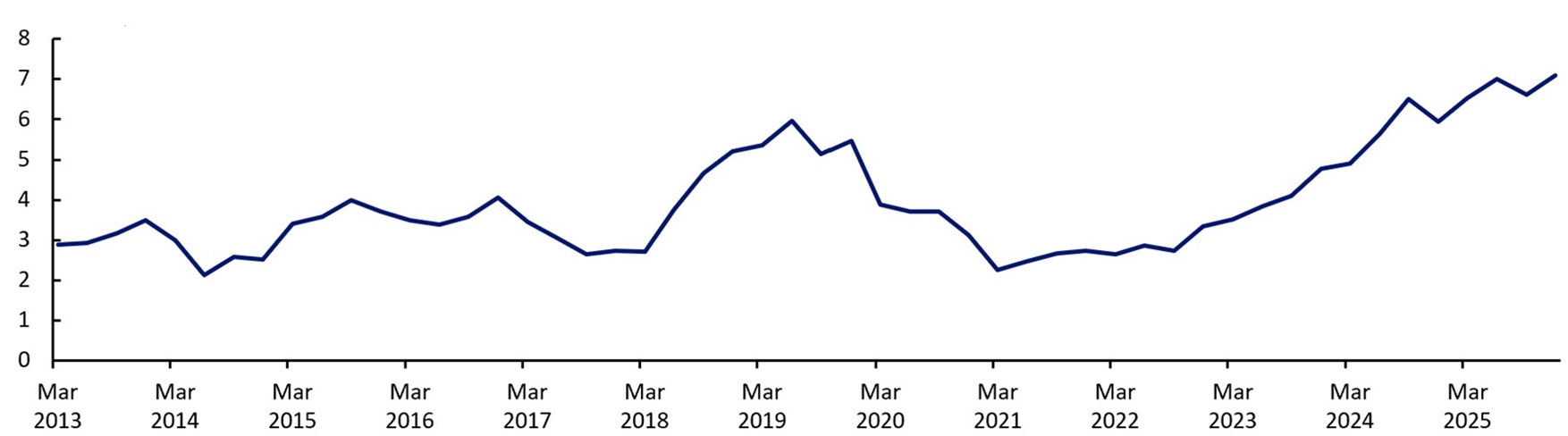
Note: Data as of Q4 2025. Numerator is the sum of long Treasury exposures (cash + derivatives) reported on SEC Form PF less the notional value of leveraged funds’ long and spreading positions in Treasury futures and options. Denominator is total marketable Treasury debt outstanding at market value.
Sources: Federal Reserve Bank of Dallas, Commodity Futures Trading Commission (CFTC), Office of Financial Research Hedge Fund Monitor, Authors’ estimate
A major driver of this trend may be the cash futures basis trade, or, simply, the basis trade, which is a relative value strategy where hedge funds take offsetting positions in Treasury securities and Treasury futures. Because profits for this trade are small, hedge funds scale positions by relying heavily on leverage through repo financing and futures margining. This leverage allows hedge funds to absorb more Treasury issuance at a time when primary dealers face balance sheet constraints.
Rising Hedge Funds’ Share of the Treasury Market
Primary dealers have traditionally served as a backstop for new Treasury issuance. However, in part resulting from post 2007-09 financial crisis capital regulation, dealers face balance sheet constraints that limit their capacity to hold Treasuries. Hedge funds, by contrast, are not subject to such constraints.
Also, some asset managers, such as mutual funds, separately managed accounts, and insurers have recently preferred Treasury futures rather than cash Treasuries for duration exposure.2 In recent years, asset manager demand for futures has grown sharply as the weighting of Treasuries increased in popular U.S. fixed income benchmark indices (Figure 2). Hedge funds are often on the other side, as shown below by the mirror increase in short futures.
Figure 2. Treasury Futures Notional Outstanding ($ billions)
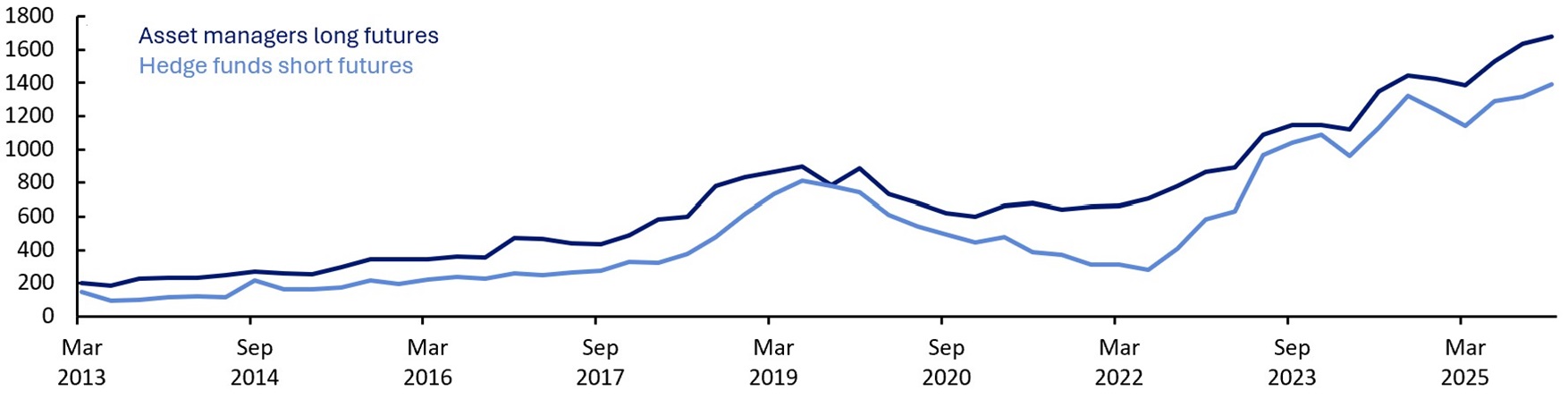
Note: Data as of Q4 2025.
Sources: Office of Financial Research Hedge Fund Monitor, Authors’ analysis.
Measuring Hedge Funds’ Cash Treasury Positions
Hedge funds’ cash Treasury holdings are not specifically reported. However, various methods approximate these holdings using a combination of SEC Form PF, which captures long Treasury exposures (cash plus derivatives), and Traders in Financial Futures data from the Commodity Futures Trading Commission (CFTC), which report long Treasury futures positions (see OFR Hedge Fund Monitor).
We estimate hedge funds’ long cash Treasury holdings at $2.0 trillion by subtracting long futures and futures‑spread positions from long Treasury exposures in SEC Form PF. In comparison, hedge funds’ short futures positions totaled $1.4 trillion. A significant share of this position is likely the basis trade; hedge funds do not separately report cash Treasury securities and derivatives on SEC Form PF. Research published in recent years by the CFTC, the Bank for International Settlements, the Federal Reserve, and sell-side firms has estimated the size of the trade to be from $350 billion to $1.5 trillion.3
The Basis Trade: A Small Profit, High‑Leverage Strategy
The Treasury basis trade involves buying a Treasury security while simultaneously shorting a futures contract with the same maturity. The trade profits from small price differences between the cash security and the futures contract. This price difference, known as the gross basis, reflects:
gross basis = Treasury security price – (futures price x conversion factor)4
However, the gross basis does not represent the hedge fund’s actual profit, as carrying costs of holding the position are omitted. These costs include repo financing costs for the long Treasury security and margin costs for the short futures position.
Futures Roll Dynamics and Profits
The profit of the basis trade is partly derived from embedded optionality in the short futures position. The seller of a futures contract has the right to choose a Treasury security from a defined basket of eligible securities to deliver at settlement. Optionality is derived from the possibility that relative valuations across the basket shift as the yield curve moves, giving the seller flexibility to deliver the least costly security, or the cheapest to deliver (CTD).5 The size of this delivery basket varies considerably by contract. Optionality also derives from delivery timing. The seller may choose which trading day within the delivery month to make delivery.
Another basis measure is the option-adjusted basis net of carry (OABnoc). This measure explicitly removes both the carry and the option value. In other words, OABnoc is the gross basis less carrying costs and a model-based estimate of the embedded option value. When the OABnoc is more negative, hedge funds have greater profit opportunity.
Treasury futures contracts expire quarterly in March, June, September, and December. Asset managers typically avoid taking delivery of Treasuries and, therefore, roll their long futures positions during the 10 trading days before First Notice Day, defined as the first date that the seller of a futures contract may notify the buyer of intent to deliver (Figure 3).6 The figure below shows the volume-weighted average OABnoc for different Treasury back month futures contracts, with each bar representing a roll period of 10 trading days.7
Figure 3. Treasury Bond Futures Estimated Cash-Futures Basis (basis point)
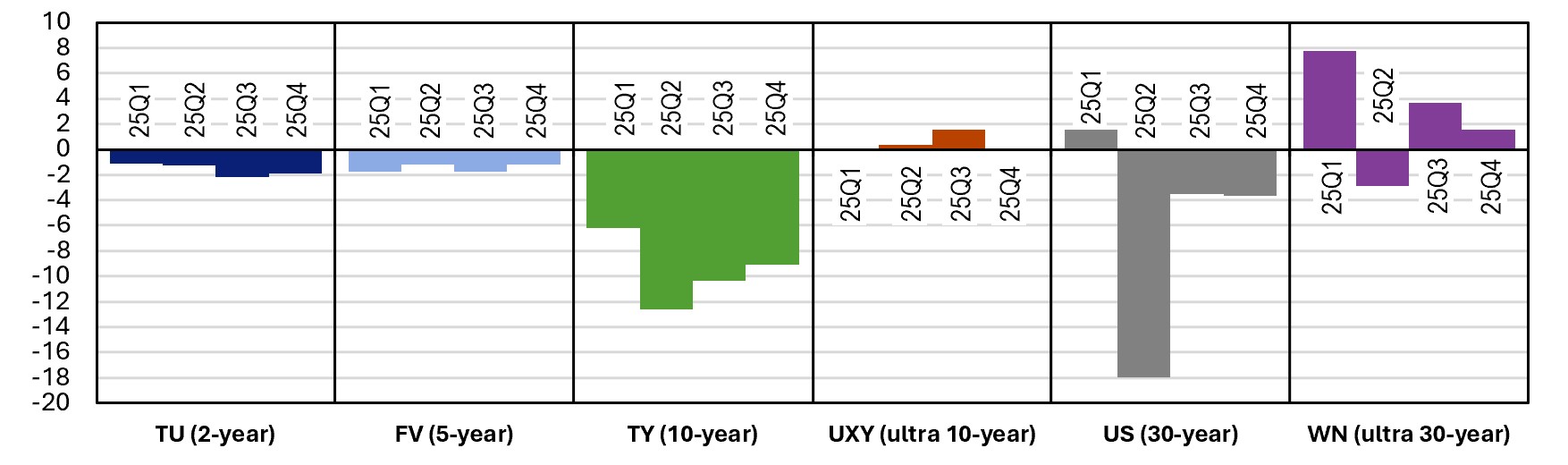
Note: Values are volume weighted average OABnoc during quarterly futures roll periods. OABnoc series is measured in Treasury price points (1 point is equivalent to 32 ticks), which are converted to basis points for illustrative purposes. Financing is assumed to be term repo (3 months).
Sources: Courtesy J.P. Morgan Chase & Co., Copyright 2026; Authors’ analysis.
As asset managers roll into the next quarterly contract, OABnoc for that contract typically becomes more negative, increasing incentives for hedge funds to take the opposite side and “go long the basis.”8 This persistent mispricing is structural in nature: Asset managers’ ongoing demand for long futures positions causes futures prices to trade at a premium relative to Treasury securities, creating a recurring profit opportunity for hedge funds willing to take the other side of the trade. Importantly, OABnoc is model dependent, and each hedge fund has its own unique assessment of this measure.
The trade’s profitability varies over time and by futures contract. In 2025, profits were higher for the 10-year (TY) and 30-year (US) contracts. A small OABnoc in other contracts does not mean they lacked basis trading activity. In fact, it may reflect the opposite: Heightened basis trading activity tends to compress arbitrage profits as hedge funds compete to exploit the same mispricing. As a result, basis traders in contracts with narrower profits are more likely to employ greater leverage to boost returns.
High Leverage
Repo financing allows hedge funds to expand their positions dramatically by rehypothecating Treasury collateral in a chain of borrow‑and‑buy transactions. Short futures positions also embed leverage because the initial margin posted supports a large notional exposure.
However, this leverage introduces risk. Hedge funds typically rely on overnight repo because it is cheaper than term financing. If repo rates spike or futures margin requirements increase abruptly, hedge funds may be forced to unwind positions rapidly. A disorderly unwinding of highly leveraged basis trades could amplify volatility in the cash and futures markets.
Conclusion
Hedge funds’ cash Treasury holdings have grown rapidly since the end of 2020, far outpacing the growth in Treasury issuance. With an estimated 7% share of marketable Treasury debt outstanding, hedge funds have reemerged as important buyers of Treasuries. Their substantial long cash Treasury and short futures positions suggest the basis trade remains large.
Hedge funds play a key role in providing liquidity to the Treasury market and in linking prices across the cash and derivatives markets. However, their reliance on leverage, especially through overnight repo, may create potential vulnerabilities.9
-
The authors would like to thank Srini Ramaswamy of the Federal Reserve Bank of Dallas and Ipek Ozil at J.P. Morgan for their insightful comments. The views expressed in this blog are those of the authors alone. Any errors or omissions remain solely the responsibility of the authors. ↩
-
Treasury Borrowing Advisory Committee, “Discussion of Treasury Futures Positions Across Different Investor Types,” January 30, 2024, https://home.treasury.gov/system/files/221/TBACCharge1Q12024.pdf. ↩
-
Eli Carter et al, “The Size of the Basis Trade,” Morgan Stanley, January 13, 2026; Scott Mixon and Alexei Orlov, “Observations on the Treasury Cash-Futures Basis Trade,” Commodity Futures Trading Commission, September 23, 2024, https://www.cftc.gov/sites/default/files/Basis_trade_Mixon_Orlov_ada.pdf; Vladyslav Sushko and Karamfil Todorov, “Sizing up hedge funds’ relative value trades in US Treasuries and interest rate swaps,” BIS Quarterly Review, December 2025, https://www.bis.org/publ/qtrpdf/r_qt2512y.htm; Jonathan Glicoes et al, “Quantifying Treasury Cash-Futures Basis Trades,” FEDS Notes, March 8, 2024, https://www.federalreserve.gov/econres/notes/feds-notes/quantifying-treasury-cash-futures-basis-trades-20240308.html. ↩
-
Each Treasury security eligible for delivery into a futures contract is assigned a conversion factor, which considers its coupon and the time remaining until maturity as of a specific delivery month. The conversion factor represents the estimated decimal price at which $1 par value of the security would trade if it had a yield to maturity of 6%, according to the Chicago Mercantile Exchange. The conversion factor serves a pragmatic role by standardizing the valuation of deliverable securities. ↩
-
As the yield curve changes, prices for securities eligible for delivery adjust differently based on their durations and convexities. If a security cheapens on a conversion factor adjusted basis by more than the current cheapest to deliver (CTD), then that security becomes the new CTD. The short futures trader profits by selling the prior CTD, buying the new CTD, and delivering this into the futures contract at settlement. ↩
-
Treasury futures contracts are physically settled. First Notice Day (FND) is the first business day when a short futures trader may issue a notice of intention to deliver the underlying Treasury security for that contract month. In practice, FND is just before the start of the formal delivery month or final month of the contract. A trader that is long futures past FND is exposed to being assigned and having to take delivery of the Treasury security. Many traders choose not to take delivery as they prefer to maintain the future exposure by rolling into the next contract. Similarly, short traders that do not intend to deliver also roll into the next contract. ↩
-
The front month is the quarterly contract with the nearest expiration date and typically has the most trading volume. A back month is any quarterly contract with an expiration later than the front month. As time passes and the current front month nears expiration, market activity rolls into the next (back month) listed contract. Upon expiration of the front month contract, that next listed contract becomes the new front month. According to CME, there is no exact definition of when the roll occurs, and theoretically, it can begin months before the expiration and occur right up until the contract’s last trading day. However, in recent history the majority of the open interest rolls during the last 10 business days before the contract month begins. ↩
-
A trader that is long the basis is also long an embedded option. The option’s value decays during convergence, reducing the profitability of the trade. If the option value is large, the trader will commonly hedge this exposure. ↩
-
Andreas Schrimpf et al., “Leverage and Margin Spirals in Fixed Income Markets during the COVID-19 Crisis,” BIS Bulletin No. 2, April 2, 2020, https://www.bis.org/publ/bisbull02.pdf ↩