
Central Clearing in Treasury Repos Plateaued in Q1 2026
Published: August 20, 2026
Views expressed are those of the authors and do not necessarily represent official positions or policy of the Office of Financial Research or the U.S. Department of the Treasury.
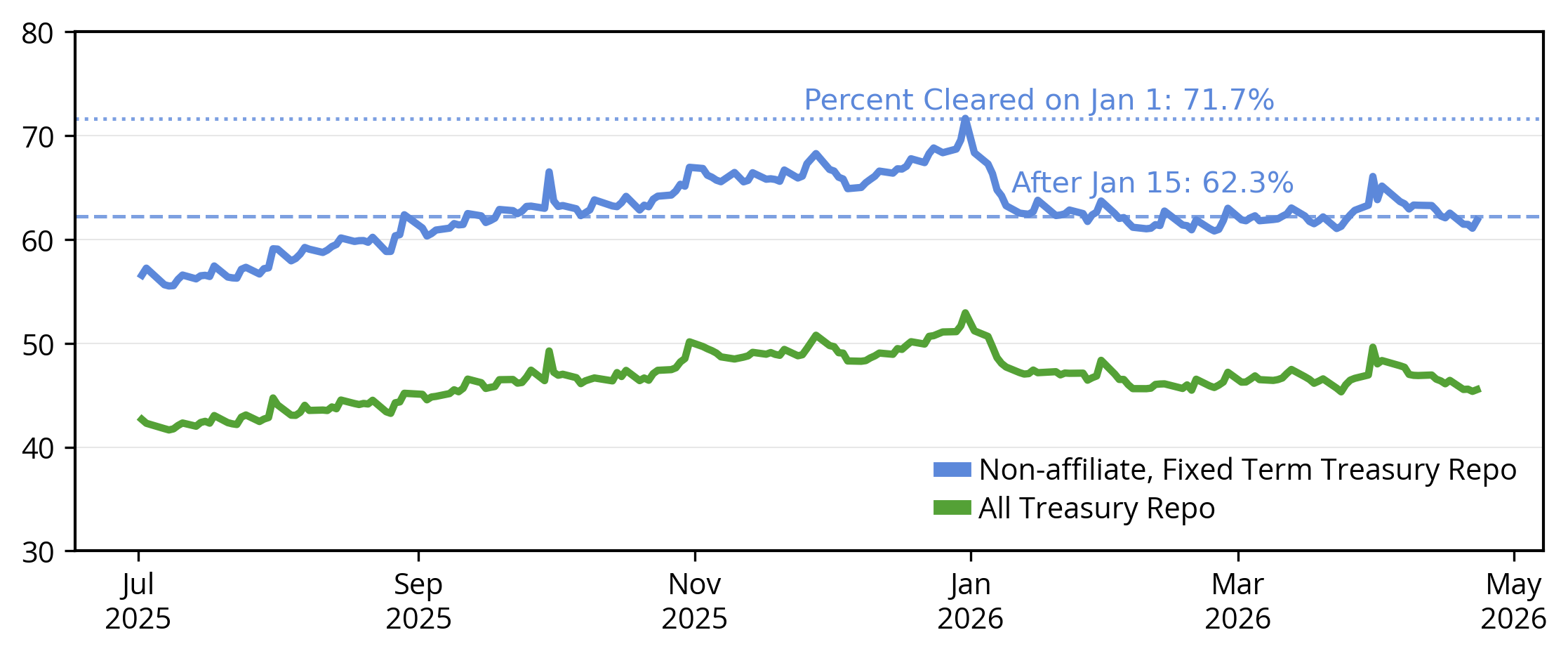
In December 2023, the Securities and Exchange Commission (SEC) adopted a rule mandating central clearing for certain Treasury repurchase agreements (repos).1 After the rule was adopted, in anticipation of required compliance, centrally cleared repo volumes increased substantially. Since July 2025, volumes increased both in proportion to all Treasury repos outstanding and to the Treasury repos in scope, namely, those that are non-affiliate and fixed-term (Figure 1). Once the peak of 53% cleared was reached, the share of centrally cleared Treasury repos fell to about 46% and has remained there since.
Figure 1. Share of Treasury Repo Cleared (percent)
Note: Data from July 1, 2025, to April 23, 2026, with federal holidays and Good Fridays removed.
Sources: Office of Financial Research, Federal Reserve Bank of New York, Bank of New York Mellon, Authors’ analysis.
The SEC mandate targets U.S. Treasury repos that are eligible to clear at a central counterparty (e.g., fixed term), and entered at arm’s length (e.g., not between affiliates).2 Clearing for the targeted subset of repos increased to 72% at the end of 2025 before declining and stabilizing at about 62% (Figure 1). This still represents a 7 percentage point increase in clearing from July 2025 when data became fully available to the Office of Financial Research (OFR). While this shows it is operationally possible for at least 72% of repo to be centrally cleared, market participants may still prefer non-centrally cleared repos in certain instances, as indicated by the decline after year-end.
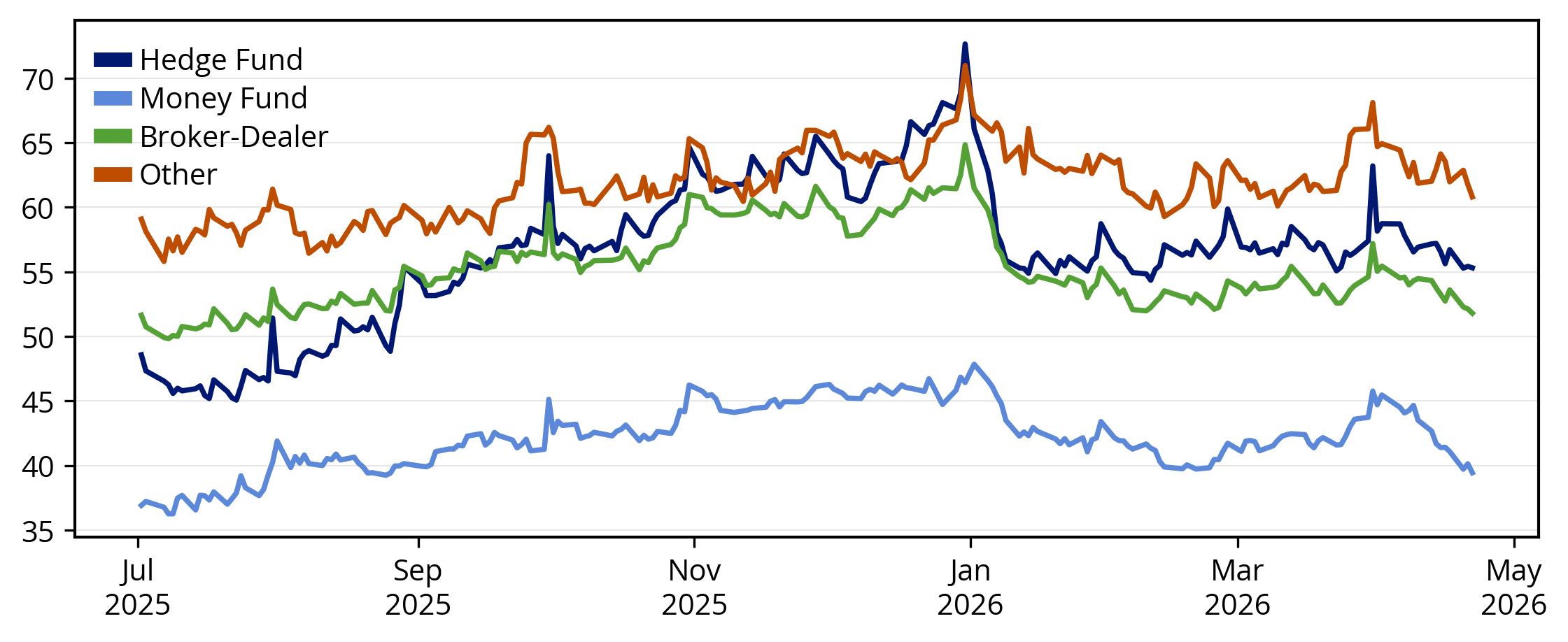
All major counterparty types, including hedge funds, money funds, and broker-dealers, show a similar pattern (Figure 2). Notably, money funds clear less than other types, with less than 50% of money market fund activity cleared. Recently, the Fixed Income Clearing Corporation (FICC) began offering a Collateral-in-Lieu service, which may lower costs to clear repo with money market funds.3
Figure 2. Cleared Treasury Repo by Counterparty Type (percent)
Note: Data from July 1, 2025, to April 23, 2026, with federal holidays and Good Fridays removed.
Sources: Office of Financial Research, Federal Reserve Bank of New York, Bank of New York Mellon, Authors’ analysis.
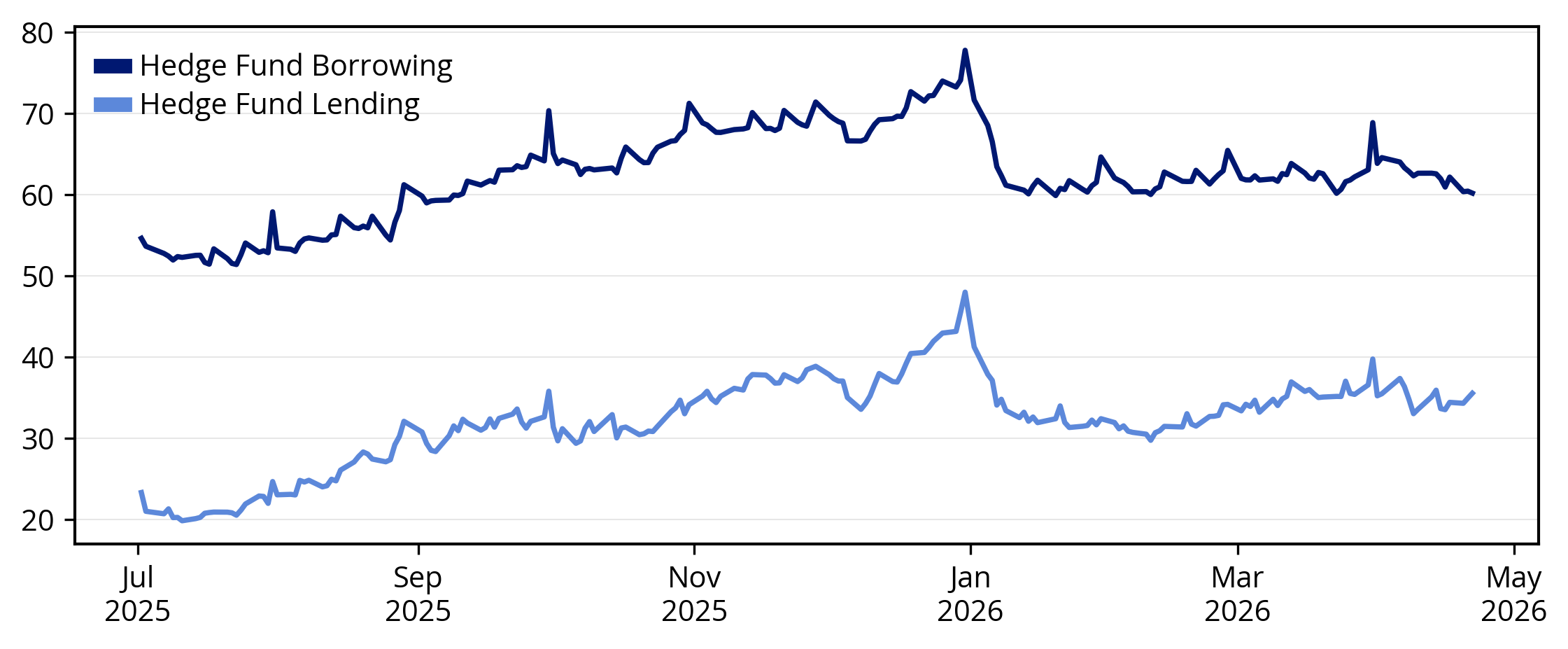
Hedge fund reverse repo (cash lending) is centrally cleared at significantly lower rates than hedge fund repo (cash borrowing) (Figure 3). Hedge funds often enter into reverse repos to borrow Treasury securities. This can be used in combination with other Treasury transactions to perform relative value trades. While these trades may sometimes pose financial stability risks, they are also an important source of liquidity to the market.4
Figure 3. Cleared Treasury Repo: Hedge Fund Repo Versus Reverse Repo (percent)
Note: Data from July 1, 2025, to April 23, 2026, with federal holidays and Good Fridays removed.
Sources: Office of Financial Research, Federal Reserve Bank of New York, Bank of New York Mellon, Authors’ analysis.
The low clearing rate for hedge funds’ reverse repos could result from operational difficulties, potentially related to central counterparty (CCP) margining practices.5 Additionally, previous OFR research suggests that hedge fund reverse repos are often matched with other repos, yielding netted packages.6 With these types of transactions, the economic incentive to centrally clear is lower because no additional regulatory balance sheet benefits are gained from the netting associated with central clearing. In either case, more hedge fund reverse repo will need to be centrally clear to comply with the central clearing rule.
Cleared Repo Decline in Q1 2026 is Concentrated in Global Systemically Important Banks
Global systemically important banks (G-SIBs) and non G-SIBs may face different incentives and constraints related to central clearing. For example, U.S. G-SIBs are subject to a G-SIB surcharge that requires holding additional Common Equity Tier 1 capital based on factors like size and interconnectedness.7 Importantly, this surcharge is calculated at year-end rather than quarter-end.8 Clearing repo can reduce the G-SIB surcharge through greater netting of exposures and the lower risk weights assigned to cleared repos.
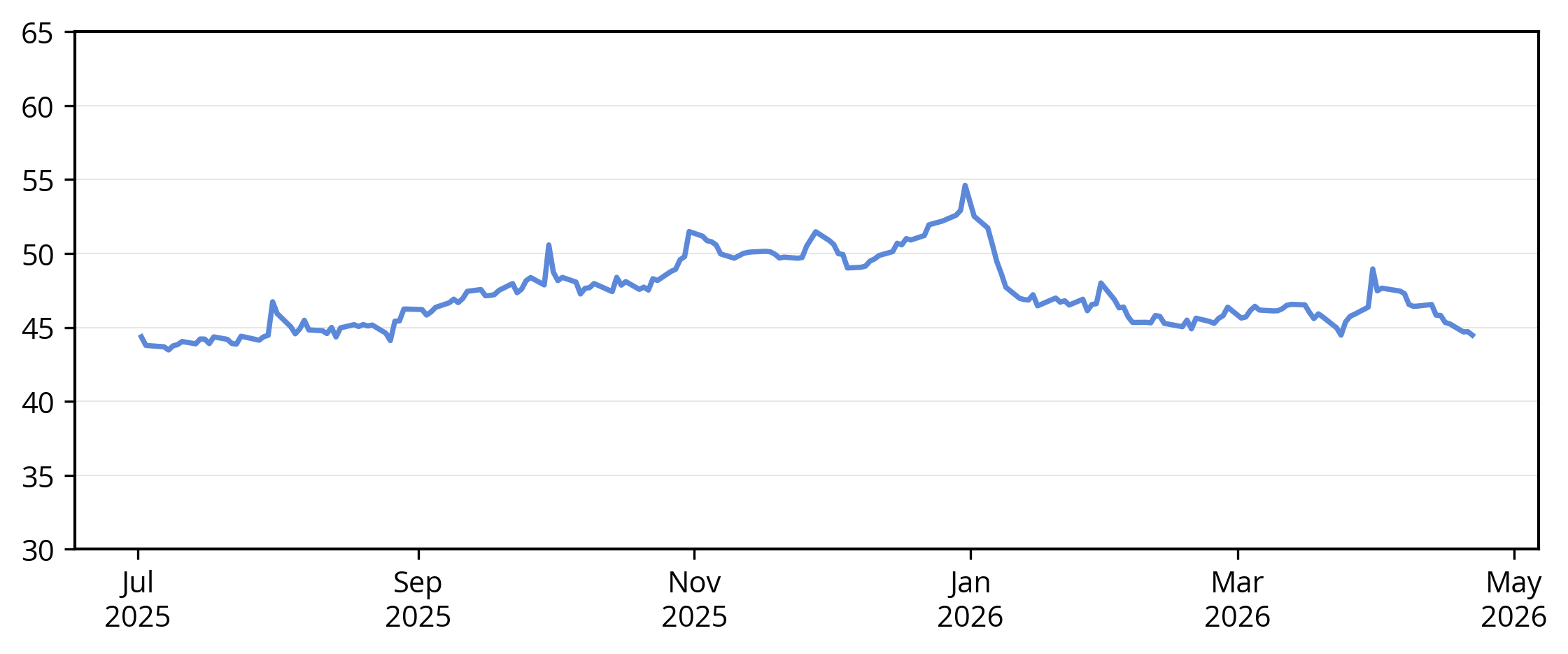
There was a noticeable increase in centrally cleared repo by G-SIBs during Q4 2025, which reached its highest level of 55% in December. This was followed by a sharp decline and eventual stabilization at 45%, which was approximately how much G-SIB repo was cleared in September 2025 (Figure 4). The 2025 year-end increase in cleared repo may reflect G-SIBs’ balance sheet and regulatory management practices related to the surcharge. In contrast, non-G-SIBs have steadily increased clearing volumes from 40% to 55% since July 2025 (Figure 5). This fact suggests G-SIBs may still see value in non-centrally cleared repo despite the benefits of netting or counterparty credit risk reduction in cleared repo.
Figure 4. Cleared Treasury Repo: G-SIBs (percent)
Note: Data from July 1, 2025, to April 23, 2026, with federal holidays and Good Fridays removed.
Sources: Office of Financial Research, Federal Reserve Bank of New York, Bank of New York Mellon, Authors’ analysis.
Figure 5. Cleared Treasury Repo: Non G-SIBs (percent)
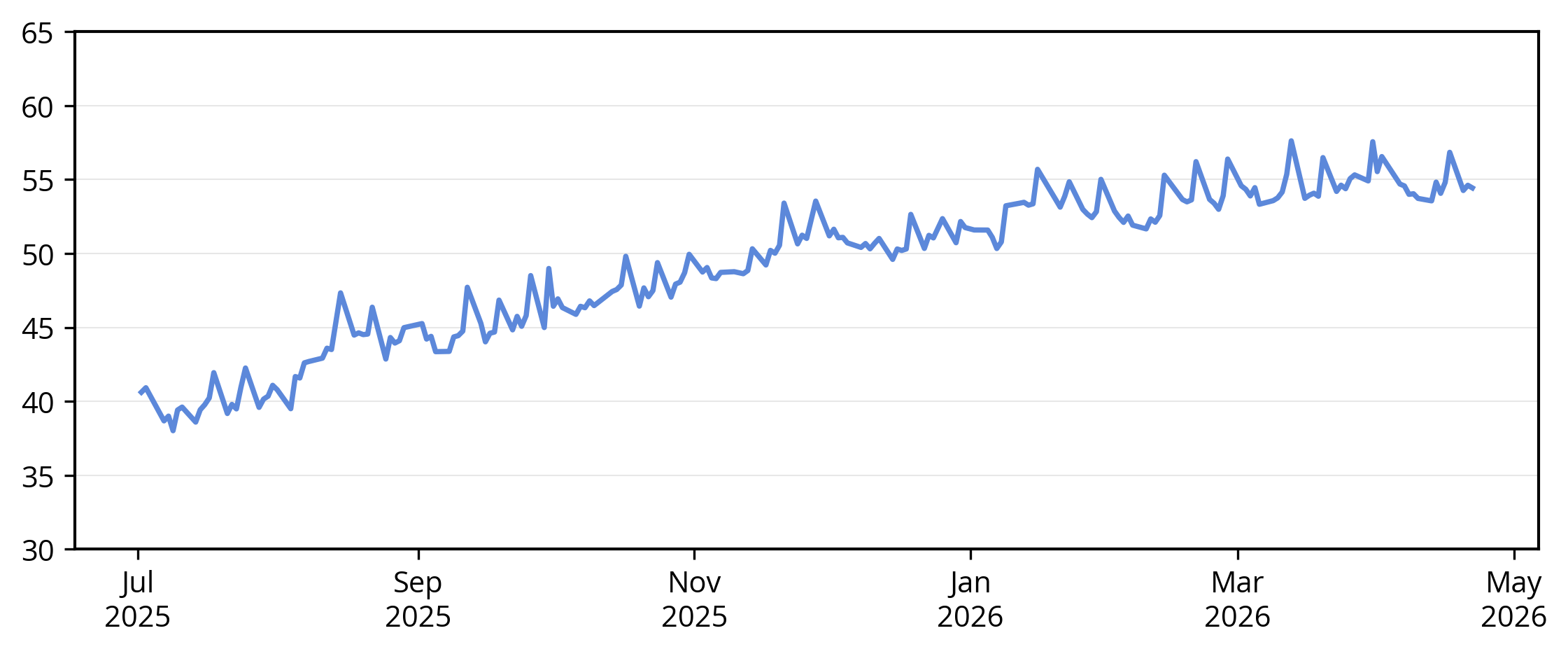
Note: Data from July 1, 2025, to April 23, 2026, with federal holidays and Good Fridays removed.
Sources: Office of Financial Research, Federal Reserve Bank of New York, Bank of New York Mellon, Authors’ analysis.
While central clearing of repos has increased substantially since the SEC’s rule was adopted, 37% of repos that are in scope are not yet cleared. The OFR’s repo collections will continue to allow for the monitoring of the progression of Treasury central clearing in repo.
-
See SEC Adopts Rules to Improve Risk Management in Clearance and Settlement and Facilitate Additional Central Clearing for the U.S. Treasury Market and SEC Extends Compliance Dates and Provides Temporary Exemption for Rule Related to Clearing of U.S. Treasury Securities. ↩
-
As of May 2026, the SEC will not require affiliate repo transactions to be centrally cleared provided the affiliated counterparty centrally clears all other eligible Treasury repos. In addition, the Fixed Income Clearing Corporation (FICC), the only U.S. Treasury repo Covered Clearing Agency (CCA) currently operating, does not offer central clearing services for repo without a fixed end date or fixed term, rendering these repos exempt from the rule. While not accounted for in this analysis, the SEC will also allow certain exclusions for repos with sovereign entities, international financial institutions, natural persons, state/local governments, and other clearing organizations. See Standards for Covered Clearing Agencies for U.S. Treasury Securities and Application of the Broker-Dealer Customer Protection Rule With Respect to U.S. Treasury Securities. ↩
-
The service implements a CCP lien on the collateral provided by dealers to money market funds. The lien is “in lieu” of margin posted to CCP by dealers. It also removes the requirement for sponsors to post a guaranty. See DTCC’s FICC and BNY Launch Collateral-in-Lieu Service. ↩
-
An example of a relative value trade where a hedge fund might perform a reverse repo to borrow a security is an on-the-run/off-the-run arbitrage trade. In this trade, hedge funds source a Treasury security that was recently auctioned (e.g., it is on-the-run) via a reverse repo and sell this Treasury. They simultaneously buy a Treasury that was not recently auctioned (e.g., it is off-the-run) and fund this second purchase funded with a repo. Importantly, these positions would be with the same counterparties (hedge fund and dealer) and would terminate on the same day. In this situation, the repo and reverse repo would net down without being centrally cleared, and less balance sheet regulatory benefits of central clearing would exist. ↩
-
Non-centrally cleared hedge fund reverse repos often have negative haircuts because the securities provider is bearing the risk that the security may not be returned. FICC’s standardized margining framework may not easily accommodate negative haircuts. ↩
-
The estimated share of hedge fund Treasury reverse repo that is netted is 68%. Samuel J. Hempel et al., “Why Is So Much Repo Not Centrally Cleared?,” OFR Brief No. 23-01 (Office of Financial Research, May 12, 2023), https://www.financialresearch.gov/briefs/2023/05/12/why-is-so-much-repo-not-centrally-cleared/. ↩
-
The G-SIB surcharge is calculated as the higher value of Method 1 and Method 2 scores. Both scores are derived from a set of systemic indicators meant to measure size, interconnectedness, complexity, and cross-jurisdictional activity, among other things. See 12 CFR 217.403. ↩
-
The G SIB surcharge is calculated annually using systemic indicator data as reported by the bank holding company as of December 31 of the preceding calendar year. See 12 CFR 217.404(b) and 12 CFR 217.405(b). ↩